This is a paper I wrote together with Thomas Hupperich, Hans Löhr, and Ahmad-Reza Sadeghi. I presented a poster on it at the 2nd ACM SIGHIT International Health Informatics Symposium (IHI 2012) in Florida, USA. In this paper we present a new security architecture for Electronic Health Records (EHR) systems in which we let the patients control the confidentiality of their EHR data in an easy an flexible way. Existing approaches to protect the privacy of EHRs are either insufficient with respect to strict privacy laws or they are too restrictive in their usage. For example, smartcard-based encryption systems require the patient to be always present to authorize access to medical records. In our approach, we propose a security architecture for EHR infrastructures that provides more flexibility but retains the security of patient-controlled encryption. In our proposal patients are able to authorize access to their records remotely (e.g. via phone) and time-independent for later processing by the physician. The security of our approach relies on modern cryptographic schemes, in particular Attribute-Based Encryption, and their incorporation into an EHR infrastructure.
The key idea of our approach is to avoid the use of smartcards as a direct input for encrypting and decrypting EHRs. Before medical data is to be stored on an EHR server, the patient provides his smartcard only to generate a transac- tion code (TAC) which will be used as authorization secret. The encryption key is only based on the TAC and the pa- tient’s identity. When the EHR is to be read again, the patient gives the TAC to the health professional who needs to access the EHR. The novelty in this approach is that pa- tients do not need to be present with their smartcards for decryption, but can provide the TAC via, e.g., phone.
More information: [Paper]
Showing posts with label E-Health. Show all posts
2012-01-29
2010-12-20
A Note on the Security in the Card Management System of the German E-Health Card
This is a paper I wrote about the German E-Health Card ("Gesundheitskarte"), where I've analyzed the security implications of the Card Management System (CMS). I presented the paper at eHealth 2010 in Casablanca, Morocco, last week. While previous work did a lot of security analysis concerning the German Healthcare Telematics infrastructure -- including network security, access control, peripheral parts, and platform security -- the card management system was neglected and got less or no notice from security experts. However, taking a closer look into the specifications from Gematik, one can find serious security flaws and conflicting requirements that ultimately lead to a loss of data sovereignty of the patient, i.e., the patient is not under control of his/her data stored in electronic health records (EHR) any more. The good news are that the deployment of the CMS and especially the EHR within the telematics is currently on hold. But the bad news are that the specification of the CMS is still in an insecure state and might be used in future when EHR systems are going to be deployed that use the eHC.
From the abstract:
The German compulsory health insurance system will introduce an electronic health card (eHC) in the near future. The eHC is supposed to enable new applications like securely storing electronic health records of patients in a central data center infrastructure so that health professionals can access these data via a common network. In this context, the card management system (CMS) is of special interest since it is used to personalize, issue, and maintain the cards. In this paper, we analyze the functional requirements specification of the CMS in Germany and identify several conflicting and ambiguous requirements. As the most important result, the specification defines technical measures that are insufficient to protect the data and data sovereignty of the patient. We discuss the resulting consequences, which might be helpful to improve the system design before its final deployment.
More information: [Paper] [Slides]
From the abstract:
The German compulsory health insurance system will introduce an electronic health card (eHC) in the near future. The eHC is supposed to enable new applications like securely storing electronic health records of patients in a central data center infrastructure so that health professionals can access these data via a common network. In this context, the card management system (CMS) is of special interest since it is used to personalize, issue, and maintain the cards. In this paper, we analyze the functional requirements specification of the CMS in Germany and identify several conflicting and ambiguous requirements. As the most important result, the specification defines technical measures that are insufficient to protect the data and data sovereignty of the patient. We discuss the resulting consequences, which might be helpful to improve the system design before its final deployment.
More information: [Paper] [Slides]
Labels:
Computer Security,
E-Health,
Gesundheitskarte
2010-11-13
Securing the E-Health Cloud
This is the title of a paper I wrote together with Hans Löhr and Ahmad-Reza Sadeghi. Today, I have presented it at IHI 2010 in Arlington, Virginia, USA. In this paper, we point out several shortcomings of current e-health solutions and standards, particularly they do not address the client platform security, which is a crucial aspect for the overall security of e-health systems. To fill this gap, we present a security architecture for establishing privacy domains in e-health infrastructures. Our solution provides client platform security and appropriately combines this with network security concepts.
We present two models of e-health clouds: a simple one pertaining Personal Health Records (PHRs), and an advanced one pertaining Electronic Health Records (EHRs). We point out the difference in the paper, and discuss three major security problem areas: (i) data storage and processing, (ii) infrastructure management, and (iii) usability.
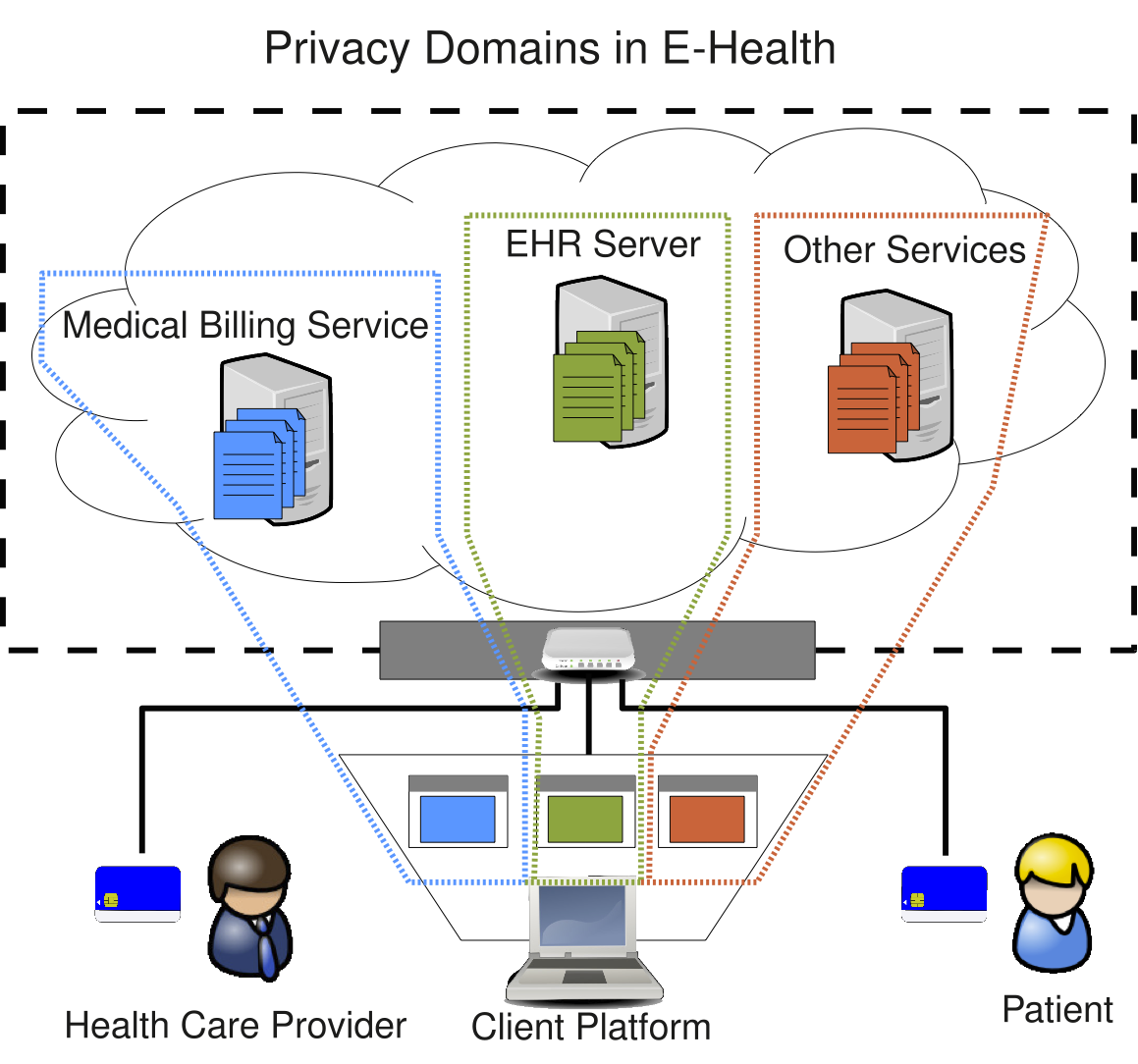
To solve on of the problems, i.e., that of client platform security, we propose to construct privacy domains for the patients’ medical data as a technical measure to support the enforce- ment of privacy and data protection policies: Systems (e.g., a client PC) must be able to partition execution environ- ments for applications into separate domains that are iso- lated from each other. Data is kept within a privacy domain, and the domain infrastructure ensures that only authorized entities can join this domain. Moreover, data leakage from the domain is prevented by the security architecture and the domain infrastructure. Therefore, the same system can be used for different work flows that are strictly isolated. The following picture shows the architecture:

Moreover, we discuss in the paper open research challenges in e-health scenarios, in particular those related to healthcare telematics infrastructures.
[Paper] [Slides]
We present two models of e-health clouds: a simple one pertaining Personal Health Records (PHRs), and an advanced one pertaining Electronic Health Records (EHRs). We point out the difference in the paper, and discuss three major security problem areas: (i) data storage and processing, (ii) infrastructure management, and (iii) usability.
To solve on of the problems, i.e., that of client platform security, we propose to construct privacy domains for the patients’ medical data as a technical measure to support the enforce- ment of privacy and data protection policies: Systems (e.g., a client PC) must be able to partition execution environ- ments for applications into separate domains that are iso- lated from each other. Data is kept within a privacy domain, and the domain infrastructure ensures that only authorized entities can join this domain. Moreover, data leakage from the domain is prevented by the security architecture and the domain infrastructure. Therefore, the same system can be used for different work flows that are strictly isolated. The following picture shows the architecture:

Moreover, we discuss in the paper open research challenges in e-health scenarios, in particular those related to healthcare telematics infrastructures.
[Paper] [Slides]
Labels:
Cloud Computing,
Computer Security,
E-Health,
TVD
Subscribe to:
Posts (Atom)